
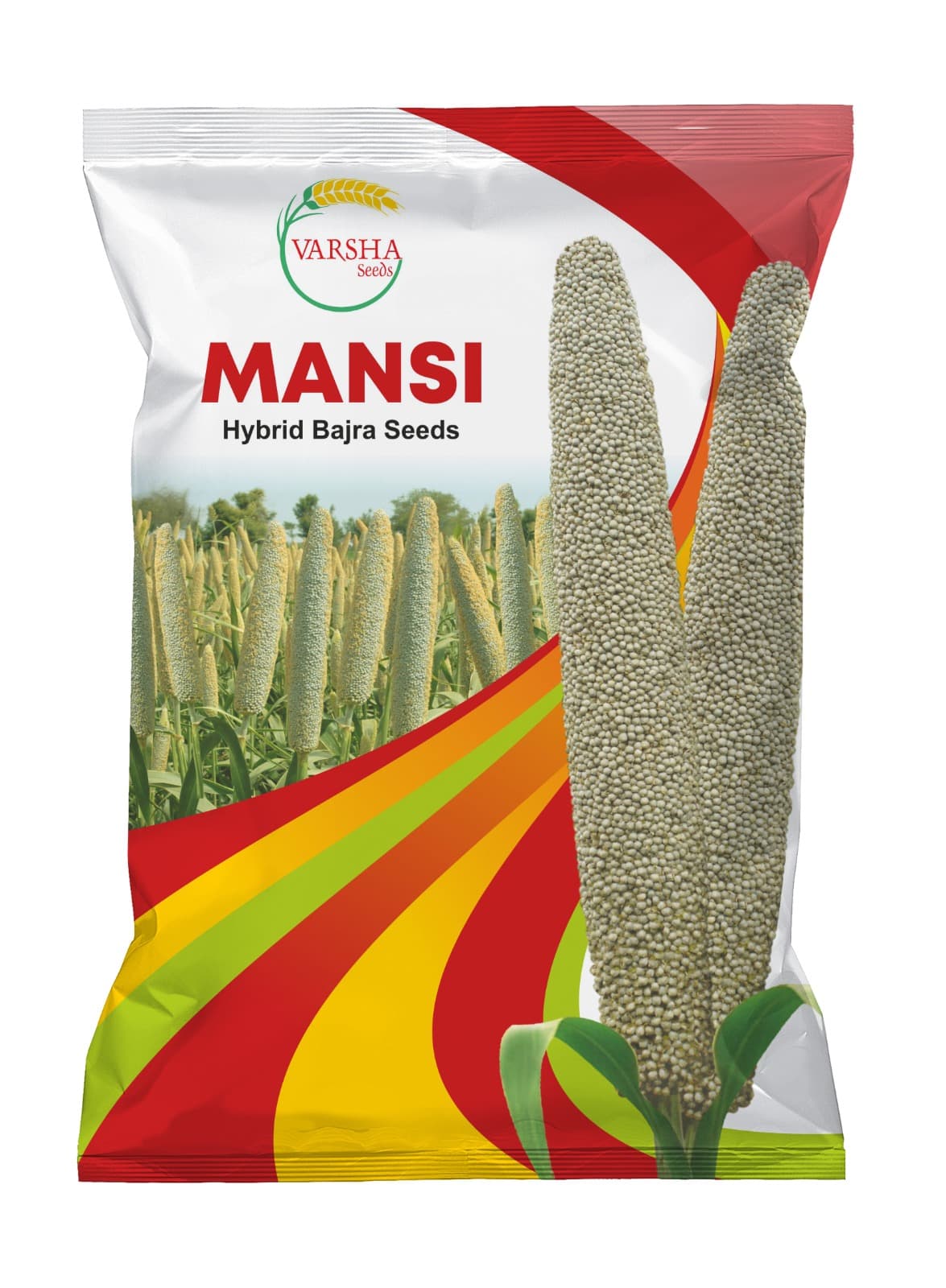
Mansi (Hybrid Bajra Seeds)
Mansi is a premium hybrid pearl millet (Bajra) variety developed for exceptional performance under harsh growing conditions. This superior hybrid delivers outstanding grain yield with excellent nutritional profile (12-13% protein, 5-6% fat, and high iron content), making it an excellent choice for both human consumption and livestock feed. Its remarkable adaptability to drought and poor soil conditions makes it the perfect crop for marginal farming areas.
Key Features
- High-performing hybrid with exceptional yield stability
- Early maturity (80-85 days) - ideal for short growing seasons
- Superior nutritional profile (12-13% protein, 5-6% fat, high iron content)
- Excellent drought tolerance - can thrive with limited moisture
- Comprehensive disease resistance (downy mildew, ergot, and smut)
- Suitable for dual-purpose use (grain and fodder)
- Outstanding adaptability to poor soil conditions
- Better response to fertilizer than traditional varieties
- Uniform crop maturity for easier harvesting
- High tillering capacity (4-5 productive tillers per plant)
- Stay-green trait improves both grain filling and fodder quality
- Suitable for intercropping systems with legumes
Growing Information
Growing Conditions
Thrives in hot, dry climates (25-35°C) with minimal rainfall (350-500 mm). Exceptionally tolerant to drought and heat stress. Performs well even in marginal soils with low fertility and slight salinity. Ideal pH range is 5.8-7.5.
Yield Estimates
Potential yield of 4-6 tons of grain per hectare under good management or 25-35 tons of green fodder per hectare when used for dual purpose.
Packaging & Usage
Available in moisture-proof packaging with seed treatment for enhanced establishment. Recommended seed rate is 6-7 kg/ha with row spacing of 45-50 cm and plant spacing of 10-15 cm.
Key Points
Key Points
- High-performing hybrid with exceptional yield stability
- Early maturity (80-85 days) - ideal for short growing seasons
- Superior nutritional profile (12-13% protein, 5-6% fat, high iron content)
- Excellent drought tolerance - can thrive with limited moisture
- Comprehensive disease resistance (downy mildew, ergot, and smut)
- Suitable for dual-purpose use (grain and fodder)
- Outstanding adaptability to poor soil conditions
- Better response to fertilizer than traditional varieties
- Uniform crop maturity for easier harvesting
- High tillering capacity (4-5 productive tillers per plant)
- Stay-green trait improves both grain filling and fodder quality
- Suitable for intercropping systems with legumes
Agronomy & Management
Soil
Extremely adaptable to various soil types including sandy and lateritic soils with low fertility. Performs best in well-drained sandy loam to loamy soils with pH 5.8-7.5. Can tolerate mild salinity and alkalinity. Not suitable for waterlogged conditions. Minimum soil depth of 20-25 cm is sufficient due to its efficient root system.
Water & Irrigation
Highly drought tolerant but responds well to limited irrigation. For rainfed cultivation, no irrigation may be needed with adequate rainfall (350-400 mm). Under irrigated conditions, 2-3 irrigations at critical stages significantly enhance yield. Critical stages for irrigation are tillering (25-30 days), flowering (45-50 days), and grain filling (60-65 days). Excess moisture during flowering may affect pollination and increase disease incidence.
Sowing
Preparation
Prepare a fine seedbed with 1-2 plowings followed by harrowing. Being a small-seeded crop, proper seed-soil contact is essential for good germination. For optimal results, apply 5-8 tons of well-decomposed farmyard manure during field preparation. In case of heavy soils, raised beds are recommended.
Sowing Depth
Sow seeds at 2.5-3.0 cm depth. Deeper sowing may result in poor emergence, while very shallow sowing may lead to drying of seeds in hot conditions.
Spacing
Maintain row to row spacing of 45-50 cm and plant to plant spacing of 10-15 cm after thinning. For fodder or dual-purpose cultivation, slightly higher plant density with 30-40 cm × 10-12 cm spacing can be adopted.
Sowing Methods
- •Line sowing: Recommended method using seed drill for uniform plant population
- •Broadcasting: Can be used in small areas but requires higher seed rate (5-6 kg/ha)
- •Transplanting: In some areas, nursery-raised seedlings are transplanted to main field
Sowing Time
Seed Rate
3.5-4.5 kg/ha for line sowing; 5-6 kg/ha for broadcasting method
Harvesting
Harvest when grains are fully mature and ears turn straw-colored, typically 80-85 days after sowing. Most plants mature uniformly, facilitating one-time harvesting. For dual-purpose use, harvest at physiological maturity (when grains are hard but green stalk remains) to get better quality fodder along with grain. Timely harvesting is important to avoid bird damage and grain shattering.
Post-Cutting Activities
After harvesting, sun-dry the earheads thoroughly for 3-4 days to bring down moisture content below 12% for safe storage. Threshing can be done manually or by threshers. For fodder, chop the stover into smaller pieces for better palatability and digestibility. Properly dried stover can be stored for off-season use.
Fertilizer
Apply basal dose of 40 kg N (85 kg urea), 20 kg P₂O₅ (100 kg SSP), and 20 kg K₂O (35 kg MOP) per hectare at sowing. Top dress with 20-30 kg N/ha (45-65 kg urea) at tillering stage (25-30 days after sowing). In low-fertility soils, application of zinc sulfate @ 15-20 kg/ha is beneficial. For organic cultivation, apply 10-12 tons of well-decomposed FYM or compost per hectare.
Weed Control
Critical weed-free period is 15-35 days after sowing. Pre-emergence application of Atrazine @ 0.5 kg a.i./ha within 2-3 days of sowing effectively controls most annual weeds. One hand weeding or inter-culture operation at 20-25 days after sowing is beneficial for weed control and soil aeration. In case of severe weed infestation, post-emergence application of 2,4-D sodium salt @ 0.75 kg a.i./ha at 20-25 days after sowing can be used.
Pest & Disease Management
Generally resistant to most pests. Occasionally shoot fly may attack young seedlings, which can be controlled by seed treatment with Thiamethoxam @ 4 g/kg of seed. Major diseases include downy mildew, ergot, and smut. Seed treatment with metalaxyl @ 6 g/kg of seed provides effective control against downy mildew. For ergot and smut, spraying Carbendazim @ 1 g/L or Propiconazole @ 1 ml/L of water at boot leaf and flowering stages provides good control. Follow crop rotation with non-host crops to break disease cycles.