
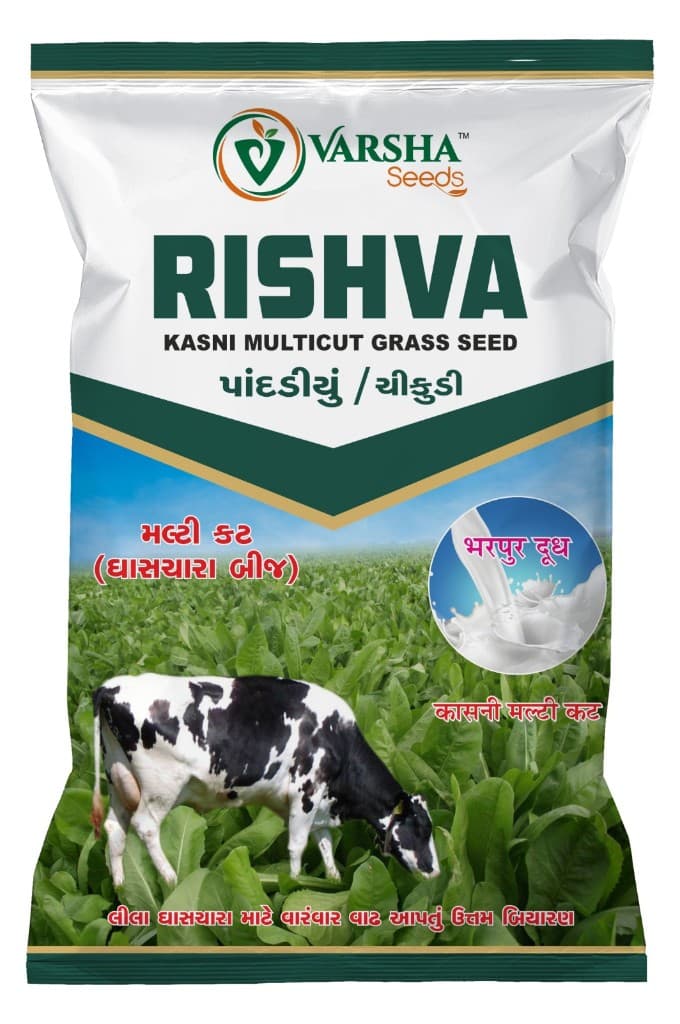
Rishva (Multicut Fodder Seeds)
Rishva, a premium Kasni (chicory) variety, is an exceptional multicut fodder developed for dairy operations. Rich in minerals, inulin, and bioactive compounds, it significantly enhances milk production and quality. Its deep root system accesses nutrients unavailable to other crops, making it an excellent companion crop for sustainable fodder systems.
Key Features
- Superior mineral content, especially calcium, phosphorus, and trace elements
- Contains inulin, a prebiotic that improves gut health in livestock
- Enhances milk production with improved fat content in dairy animals
- Deep tap root system (up to 1.5m) accesses nutrients from deeper soil layers
- Drought tolerant once established due to extensive root system
- Lower water requirement compared to other fodder crops
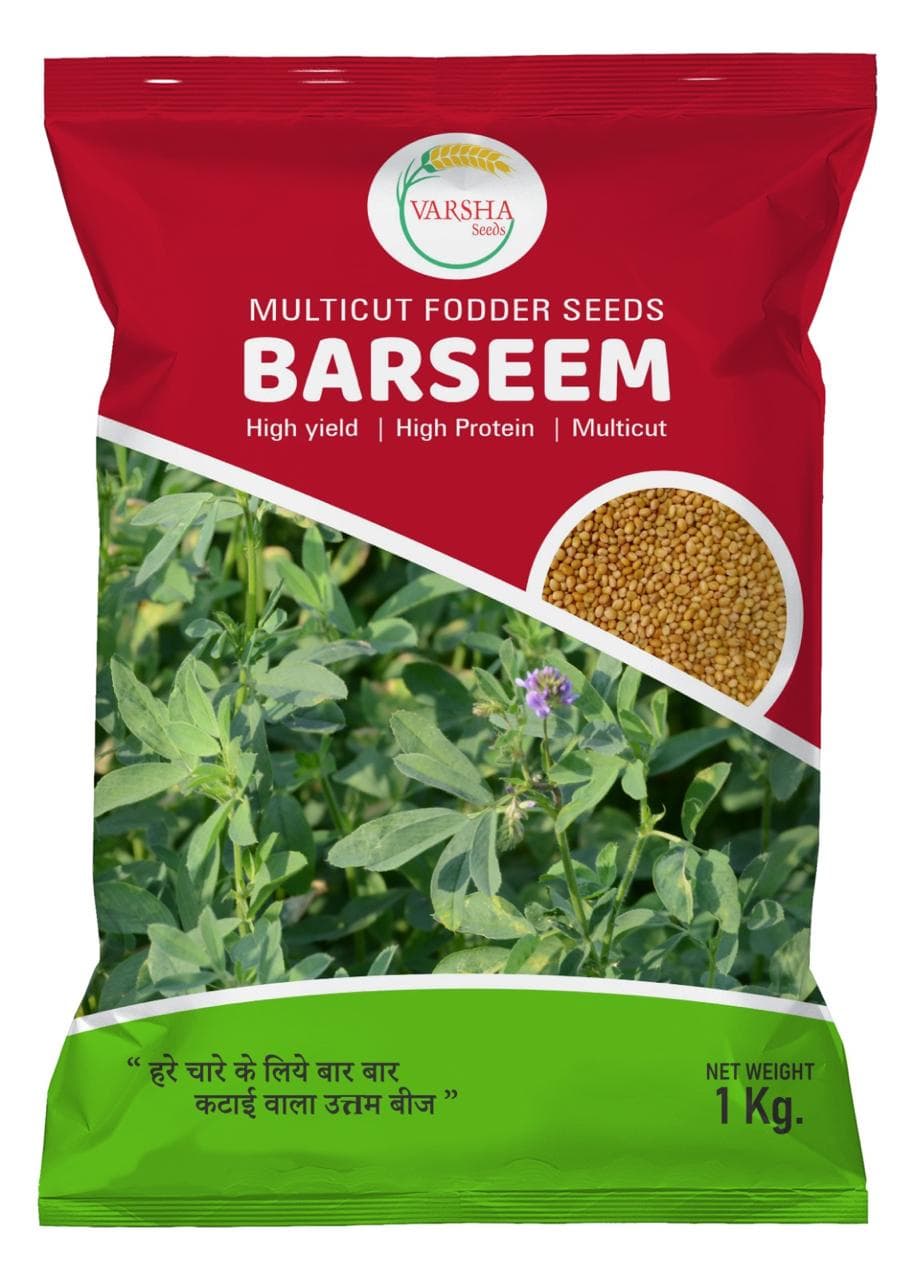
- Excellent companion crop for legume fodders like Barseem
- Contains bioactive compounds with anthelmintic properties
- Improves overall palatability of mixed fodder
- Enhances utilization of non-protein nitrogen in ruminants
- Particularly beneficial during winter season fodder scarcity
- Ideal for sustainable and organic livestock farming systems
Growing Information
Growing Conditions
Prefers cool to mild climates (15-25°C) and well-drained, fertile soils (pH 5.5-7.0). Typically sown in early winter (October-November) in northern India. Requires regular irrigation (every 15-20 days).
Yield Estimates
Can produce 40-60 tons of green fodder per hectare over multiple cuts in a season (120-150 days).
Packaging & Usage
Seed rate: 30-40 kg/ha when sown as a pure crop
Key Points
Key Points
- Superior mineral content, especially calcium, phosphorus, and trace elements
- Contains inulin, a prebiotic that improves gut health in livestock
- Enhances milk production with improved fat content in dairy animals
- Deep tap root system (up to 1.5m) accesses nutrients from deeper soil layers
- Drought tolerant once established due to extensive root system
- Lower water requirement compared to other fodder crops
- Excellent companion crop for legume fodders like Barseem
- Contains bioactive compounds with anthelmintic properties
- Improves overall palatability of mixed fodder
- Enhances utilization of non-protein nitrogen in ruminants
- Particularly beneficial during winter season fodder scarcity
- Ideal for sustainable and organic livestock farming systems
Agronomy & Management
Soil
Adaptable to a wide range of soil types but performs best in deep, well-drained loamy soils with pH 5.5-7.0. Can tolerate slightly acidic conditions but not waterlogging. Good organic matter content enhances growth and yield. Minimum soil depth of 45 cm recommended due to its deep rooting habit.
Water & Irrigation
Moderate water requirement with efficient utilization. First irrigation immediately after sowing. Subsequent irrigations at 15-20 day intervals depending on soil moisture and weather conditions. Critical irrigation periods are at seedling establishment and after each cutting. More frequent irrigation (10-12 days interval) required in light soils.
Sowing
Preparation
Prepare a fine, firm seedbed as seeds are small. Two plowings followed by harrowing and planking is recommended. Apply well-decomposed farmyard manure (10-12 tons/ha) during land preparation. Ensure weed-free field before sowing.
Sowing Depth
Very shallow sowing at 0.5-1.0 cm depth is crucial due to small seed size. Seeds should be mixed with fine sand for uniform distribution during broadcasting.
Spacing
Row to row spacing of 30 cm when sown as pure crop; when intercropped with legumes, alternate rows at 25-30 cm spacing is recommended.
Sowing Methods
- •Broadcasting: Most common method, seeds mixed with fine sand for uniform distribution
- •Line sowing: Precision placement for better establishment, using specialized seed drills
- •Intercropping: Alternate rows or mixed sowing with legume fodders like Barseem (most recommended)
Sowing Time
Seed Rate
4-5 kg/ha for pure stands; 2-3 kg/ha when mixed with legume fodders
Harvesting
First cutting at 70-80 days after sowing when plants are 40-50 cm tall. Subsequent cuttings at 35-45 day intervals. Cut at 6-8 cm above ground level for better regrowth. For optimal nutritive value, harvest before flowering stage. Mixed stands with legumes should be harvested based on the growth stage of the companion crop.
Post-Cutting Activities
Light irrigation immediately after cutting. Apply 20-25 kg N/ha (45-55 kg urea) after each cutting except the last one. Remove any weeds that emerge after cutting to prevent competition with regrowth.
Fertilizer
Basal application: 25-30 kg N (55-65 kg urea), 50-60 kg P₂O₅ (250-300 kg SSP), and 30 kg K₂O (50 kg MOP) per hectare at sowing time. Top dressing: 20-25 kg N/ha after each cutting for pure stands; reduce to 15-20 kg N/ha for mixed stands with legumes. Micronutrients particularly zinc and boron are beneficial for yield enhancement.
Weed Control
Critical weed-free period is first 40-45 days. Pre-emergence application of Pendimethalin @ 0.75 kg a.i./ha can be used for initial weed control. Hand weeding at 30-35 days after sowing is essential due to slow initial growth. Inter-row cultivation in line-sown crops helps in weed management.
Pest & Disease Management
Generally resistant to most pests. Occasionally leaf-eating caterpillars may appear which can be controlled by spraying Neem-based insecticides @ 5 ml/L of water. Powdery mildew in humid conditions can be managed by spraying wettable sulfur @ 2 g/L of water or improving air circulation by reducing plant density.