
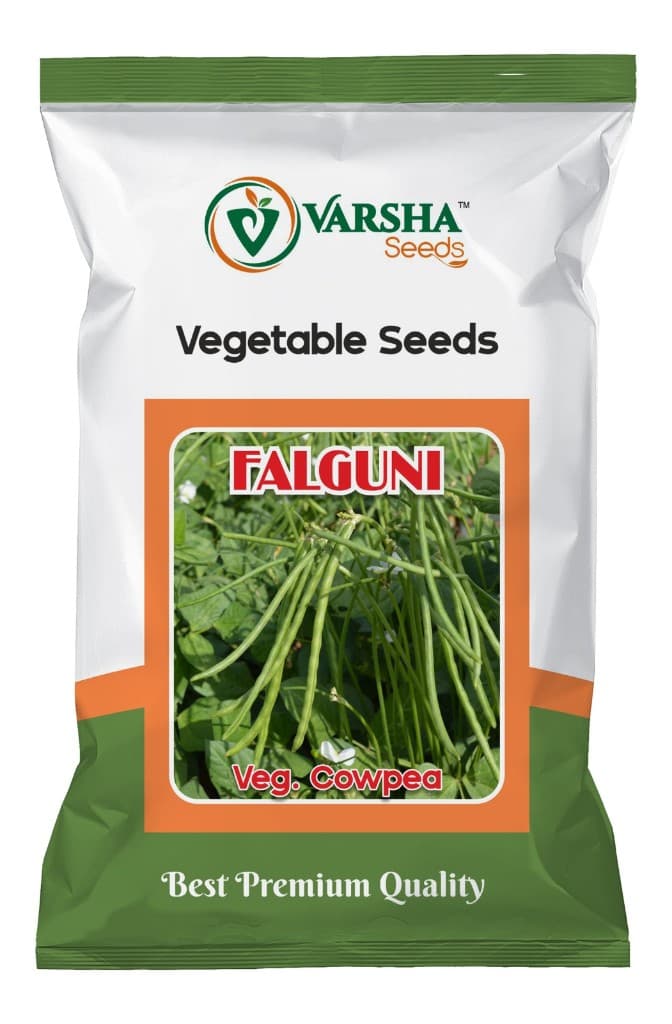
Fhalguni Veg Choli (Cowpea)
Cowpea for vegetable use. Suited to well-drained loam to slightly heavy soils; in cooler climates, slightly sandy soils help earlier maturity. Kharif (early June–late July), South India Rabi (Oct–Nov), Summer (Mar for grain; Feb for fodder), green manure mid‑June–early July.
Key Features
- Sowing by broadcasting, line sowing, or dibbling; line > broadcast for grain; broadcast preferred for fodder/green manure
- Apply 5–10 t/ha FYM as basal during last ploughing
- Poor soils: starter 15–20 kg N/ha (OC < 0.5%), 50–60 kg P2O5/ha, 50–60 kg K2O/ha; P & K as per soil test
- Summer crop: irrigation is most critical after weeding and fertilization
- Short waterlogging tolerance (~2 days) only at flowering/pod setting—longer reduces yield/quality
Growing Information
Growing Conditions
Best on well-drained loam or slightly heavy soils; in cooler zones, slightly sandy soils preferred for earlier maturity. Two ploughings + planking usually sufficient. Keep crop weed-free up to 25–30 DAS.
Yield Estimates
Vegetable: green pods 45–90 DAS depending on variety. Grain: harvest 90–125 DAS at full maturity; dry and thresh; sun-dry grains before storage. Fodder: 40–45 DAS depending on requirement.
Packaging & Usage
Seed rate pure crop (grain): 12–18 kg/ha; fodder/green manure: 30–35 kg/ha. Summer: 12–15 kg/ha (grain), 40 kg/ha (fodder/green manure). Spacing: rows 45–30 cm, plants 10–15 cm.
Key Points
Key Points
- Sowing by broadcasting, line sowing, or dibbling; line > broadcast for grain; broadcast preferred for fodder/green manure
- Apply 5–10 t/ha FYM as basal during last ploughing
- Poor soils: starter 15–20 kg N/ha (OC < 0.5%), 50–60 kg P2O5/ha, 50–60 kg K2O/ha; P & K as per soil test
- Summer crop: irrigation is most critical after weeding and fertilization
- Short waterlogging tolerance (~2 days) only at flowering/pod setting—longer reduces yield/quality
Agronomy & Management
Soil
Well-drained loam to slightly heavy; in cool climates slightly sandy soils for earliness.
Water & Irrigation
For summer, 5–6 irrigations at 10–15 day intervals depending on soil and weather; importance order: flowering → pod filling → vegetative. Avoid prolonged waterlogging.
Sowing
Preparation
Two ploughings followed by planking on normal soils. Treat seed with Thiram 2 g + Carbendazim 1 g/kg; inoculate with Rhizobium @ 10 g/kg.
Sowing Depth
Sow at 2–3 cm depth to ensure uniform emergence.
Spacing
Row: 45–30 cm; Plant: 10–15 cm.
Sowing Methods
- •Broadcasting (preferred for fodder/green manure)
- •Line sowing (better than broadcasting for grain)
- •Dibbling depending on purpose/season
Sowing Time
Seed Rate
12–18 kg/ha (grain); 30–35 kg/ha (fodder/green manure). Summer: 12–15 kg/ha (grain); 40 kg/ha (fodder/green manure)
Harvesting
Vegetable: pick green pods 45–90 DAS by variety. Grain: harvest 90–125 DAS at full maturity; dry, thresh, and sun‑dry grains before storage. Fodder: harvest 40–45 DAS as needed.
Fertilizer
Basal: FYM/compost 5–10 t/ha. Poor soils: 15–20 kg N/ha (OC <0.5%), 50–60 kg P2O5/ha, 50–60 kg K2O/ha (as per soil test).
Weed Control
Keep weed‑free up to 25–30 DAS for higher yield.
Pest & Disease Management
Diseases—bacterial blight: Copper Oxychloride 0.2% (2 g/L); mosaic (via aphids): Oxydemeton‑methyl 25 EC 1 ml/L or Imidacloprid 17.8 SL 0.2 ml/L; repeat after 10 days. Powdery mildew: Wettable sulphur 3 g/L or Carbendazim 1 g/L. Insects—pod borer: dust 2% Methyl Parathion 25–30 kg/ha or spray Quinalphos 2 ml/L; install 3‑ft bird perches @10/ha. Hairy caterpillar: Chlorpyrifos/Quinalphos 2 ml/L. Aphids/green leafhopper: Oxydemeton‑methyl 25 EC 1 ml/L or Dimethoate 30 EC 1.7 ml/L.