
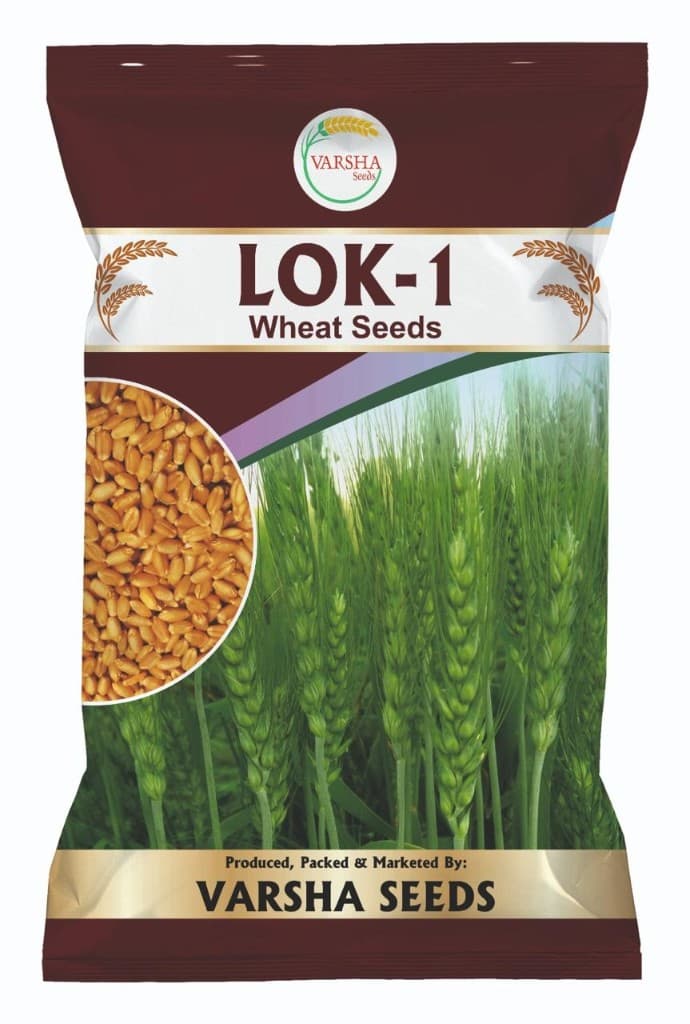
LOK-1 (Wheat Seeds)
LOK-1 is a time-tested bread wheat variety released in 1981 from ARS Vijapur (Gujarat). Widely grown across Gujarat, Madhya Pradesh, Maharashtra and Rajasthan, it is valued for its early maturity, drought tolerance under limited irrigation, and bold amber grains with excellent chapati quality.
Key Features
- Time-tested 1981 release from ARS Vijapur, GAU — proven track record across decades
- Early-maturing (~105-110 days) — vacates field early, ideal for double-cropping with kharif paddy or cotton
- Drought-tolerant — gives reliable yields even with just 1-2 irrigations
- Yield potential 45-55 q/ha under irrigated, 30-40 q/ha under restricted irrigation
- Bold, lustrous amber grains preferred for atta milling and home chapati
- Plant height ~90-95 cm — tolerates lodging in moderate-fertility soils
- Suitable for timely (early November) as well as late (up to mid-December) sowing
- Moderate resistance to brown rust and Karnal bunt
- High test weight (~40-42 g per 1000 grains) with good flour recovery
- Best adapted to Gujarat, Saurashtra, Kutch, MP, Maharashtra, Rajasthan plains
Growing Information
Growing Conditions
Performs best in cool, dry rabi conditions (15-25°C). Suitable for medium to heavy black or alluvial soils with pH 6.5-7.5. Tolerates limited irrigation; 3-4 irrigations are sufficient for good yields.
Yield Estimates
45-55 q/ha under timely sowing with full irrigation; 30-40 q/ha under restricted (1-2) irrigation. Performs reliably even in rainfed pockets of central and western India.
Packaging & Usage
Recommended seed rate: 100-125 kg/ha for line sowing. Available in standard 20 kg woven sacks; bulk packs supplied on request.
Key Points
Key Points
- Time-tested 1981 release from ARS Vijapur, GAU — proven track record across decades
- Early-maturing (~105-110 days) — vacates field early, ideal for double-cropping with kharif paddy or cotton
- Drought-tolerant — gives reliable yields even with just 1-2 irrigations
- Yield potential 45-55 q/ha under irrigated, 30-40 q/ha under restricted irrigation
- Bold, lustrous amber grains preferred for atta milling and home chapati
- Plant height ~90-95 cm — tolerates lodging in moderate-fertility soils
- Suitable for timely (early November) as well as late (up to mid-December) sowing
- Moderate resistance to brown rust and Karnal bunt
- High test weight (~40-42 g per 1000 grains) with good flour recovery
- Best adapted to Gujarat, Saurashtra, Kutch, MP, Maharashtra, Rajasthan plains
Agronomy & Management
Soil
Prefers well-drained medium to heavy black soils or alluvial loams with pH 6.5-7.5. Tolerates somewhat marginal soils better than newer varieties. Avoid waterlogged or highly saline fields.
Water & Irrigation
Critical irrigations at crown root initiation (20-25 DAS), tillering (40-45 DAS) and grain filling (80-85 DAS). 3-4 total irrigations under full schedule; gives acceptable yields with just 1-2 irrigations under favourable rainfall.
Sowing
Preparation
Two cross ploughings followed by harrowing and planking to produce a fine, firm seedbed. Apply 8-10 t/ha of well-decomposed FYM during land preparation.
Sowing Depth
4-5 cm depth ensures good emergence; deeper sowing reduces germination.
Spacing
Line sowing at 20-22 cm row spacing for irrigated; 22-25 cm for rainfed/limited-irrigation conditions.
Sowing Methods
- •Line sowing with seed drill (preferred for uniform stand)
- •Broadcasting followed by light harrowing (requires higher seed rate)
- •Zero-tillage after paddy/cotton in suitable soils
Sowing Time
Seed Rate
100 kg/ha for timely line sowing; 125 kg/ha for late or broadcast sowing
Harvesting
Harvest when grains are hard, straw turns golden-yellow, and grain moisture is 18-20%. Avoid over-ripening to prevent shattering losses. Combine harvesting works well for large areas.
Post-Cutting Activities
Thresh promptly and sun-dry grains to safe storage moisture (~12%). Store in clean, dry bins; treat seed lots with neem-based protectants for long-term storage.
Fertilizer
Apply 120:60:40 kg NPK/ha for irrigated fields (80:40:30 for rainfed). Full P and K + half N as basal; remaining half N as top-dress at first irrigation (CRI stage). Where zinc-deficient, apply 25 kg ZnSO4/ha basal.
Weed Control
Pre-emergence Pendimethalin 30 EC @ 3.3 L/ha in 800-1000 L water within 1-2 days of sowing. Post-emergence 2,4-D sodium salt @ 625 g in 600 L water at 30-35 DAS for broadleaf weeds. Hand weeding at 30-35 DAS where needed.
Pest & Disease Management
Major diseases: brown rust, Karnal bunt, loose smut. Seed treatment with Carboxin 75 WP @ 2.5 g/kg seed controls smuts. Spray Propiconazole 25 EC @ 1 mL/L at boot stage for rust. Termites: seed treat with Chlorpyriphos 20 EC @ 4 mL/kg seed.