
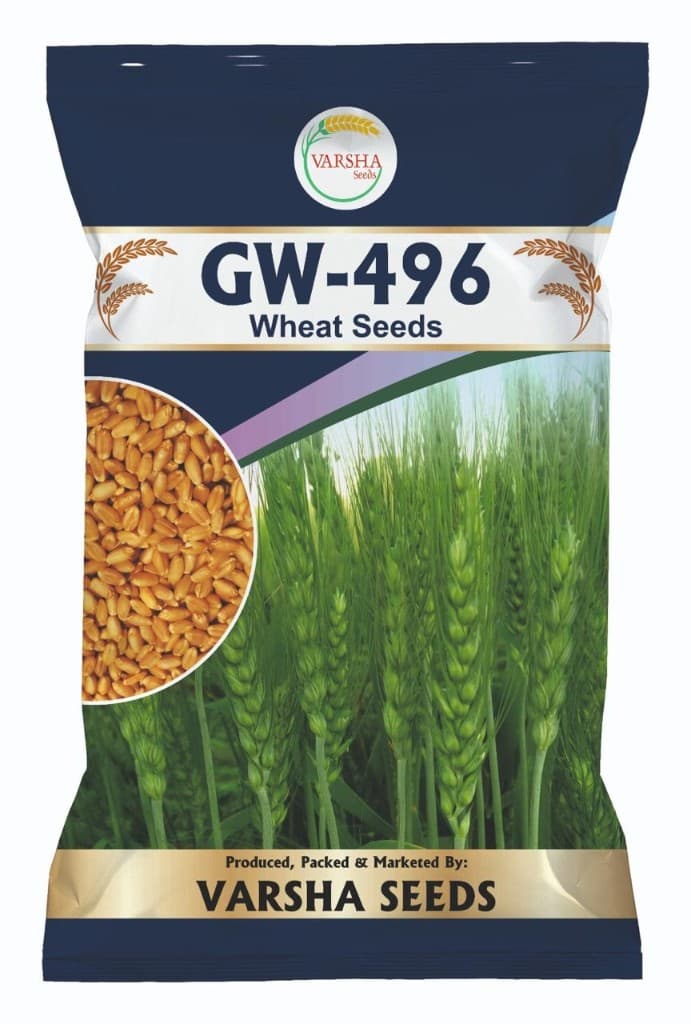
GW-496 (Wheat Seeds)
GW-496 (Gujarat Wheat 496) is a high-yielding bread wheat variety developed by the Wheat Research Station, Junagadh. Recommended for timely-sown, irrigated rabi conditions across Gujarat, Saurashtra and Kutch, it produces bold lustrous amber grains with high protein content and is well suited for both chapati and bakery use.
Key Features
- Developed at Wheat Research Station, Junagadh — proven for Gujarat agro-climatic conditions
- High-yielding variety: 50-60 q/ha under full irrigation; up to 65 q/ha under best management
- Bold, lustrous amber grains with high test weight (~42-45 g per 1000 grains)
- High protein content (~12-13%) — excellent for chapati, atta and bakery use
- Strong, semi-dwarf plant (~90-95 cm) with good lodging resistance
- Resistant to brown rust; moderately resistant to yellow rust and Karnal bunt
- Optimum maturity ~115-120 days — fits standard rabi calendar
- Best for timely sowing (first fortnight of November) under irrigated conditions
- Excellent response to balanced NPK fertilisation and timely irrigation
- Recommended across Gujarat, Saurashtra and Kutch irrigated tracts
Growing Information
Growing Conditions
Best suited to cool rabi conditions (15-25°C) on well-drained medium black or alluvial soils with pH 6.5-7.5. Requires 4-5 timely irrigations for full yield expression.
Yield Estimates
Average 50-60 q/ha under timely sown irrigated conditions in Gujarat plains; up to 65 q/ha under best management. Responds strongly to balanced fertilisation and timely irrigations.
Packaging & Usage
Seed rate: 100-125 kg/ha for line sowing. Packed in standard 20 kg woven sacks; certified seed available.
Key Points
Key Points
- Developed at Wheat Research Station, Junagadh — proven for Gujarat agro-climatic conditions
- High-yielding variety: 50-60 q/ha under full irrigation; up to 65 q/ha under best management
- Bold, lustrous amber grains with high test weight (~42-45 g per 1000 grains)
- High protein content (~12-13%) — excellent for chapati, atta and bakery use
- Strong, semi-dwarf plant (~90-95 cm) with good lodging resistance
- Resistant to brown rust; moderately resistant to yellow rust and Karnal bunt
- Optimum maturity ~115-120 days — fits standard rabi calendar
- Best for timely sowing (first fortnight of November) under irrigated conditions
- Excellent response to balanced NPK fertilisation and timely irrigation
- Recommended across Gujarat, Saurashtra and Kutch irrigated tracts
Agronomy & Management
Soil
Best on well-drained medium black or alluvial loam soils with pH 6.5-7.5 and good fertility. Avoid saline or waterlogged fields.
Water & Irrigation
Critical irrigations at CRI (20-25 DAS), tillering (40-45 DAS), jointing (60-65 DAS), flowering (80-85 DAS) and grain filling (100-105 DAS). Total 4-5 irrigations for full yield.
Sowing
Preparation
Two ploughings followed by planking. Apply 10-12 t/ha well-decomposed FYM during land preparation for higher yields.
Sowing Depth
Sow at 4-5 cm depth for good emergence and tillering.
Spacing
Line sowing at 20-22 cm row spacing is optimum for irrigated conditions.
Sowing Methods
- •Line sowing with seed drill (preferred for higher yields)
- •Bed planting for water-saving irrigated systems
- •Zero-tillage after paddy/cotton in compatible soils
Sowing Time
Seed Rate
100 kg/ha for timely line sowing; 125 kg/ha for late sowing or broadcast
Harvesting
Harvest at physiological maturity when grains are hard and straw is golden-yellow. Combine harvesting at grain moisture of 18-20% is ideal; avoid delays to prevent shattering.
Post-Cutting Activities
Sun-dry threshed grain to ~12% moisture before storage. Clean and grade before bagging; treat with edible-grade protectants for long storage.
Fertilizer
Apply 150:60:40 kg NPK/ha. Full P, K and half N as basal; remaining N split at first and second irrigations. Apply 25 kg ZnSO4/ha basal in zinc-deficient soils. Foliar 2% urea at heading stage boosts grain protein.
Weed Control
Pre-emergence Pendimethalin 30 EC @ 3.3 L/ha within 1-2 days of sowing. Post-emergence Sulfosulfuron 75 WG @ 25 g a.i./ha at 25-30 DAS controls Phalaris minor. Hand weeding once at 30-35 DAS as supplement.
Pest & Disease Management
Major diseases: brown rust, yellow rust, Karnal bunt. Seed treatment with Carboxin 75 WP @ 2.5 g/kg + Tebuconazole 2 DS @ 1.25 g/kg controls smuts and bunts. Spray Propiconazole 25 EC @ 1 mL/L at boot/heading for rust. For aphids: Imidacloprid 17.8 SL @ 100 mL/ha.