
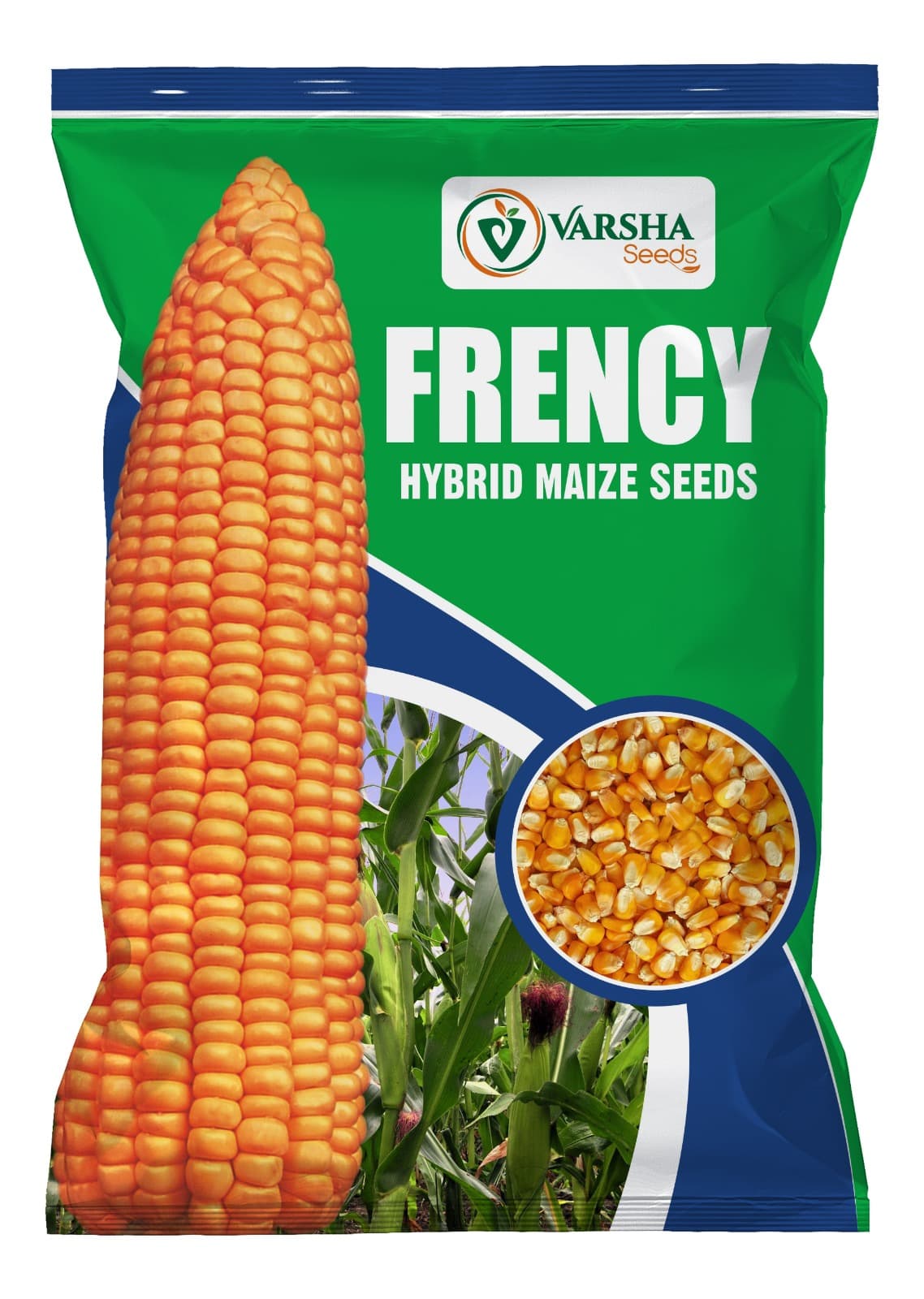
Frency (Hybrid Maize Seeds)
Frency is an elite hybrid maize variety specially bred for exceptional performance in diverse growing conditions. This advanced hybrid delivers outstanding grain yield with superior nutritional quality and excellent starch content, making it ideal for both food processing and animal feed. Its remarkable stress tolerance and disease resistance package ensure reliable performance even under challenging environments.
Key Features
- Elite high-yielding single-cross hybrid (8-12 tons/ha)
- Medium maturity (100-125 days) with excellent dry-down characteristics
- Superior grain quality with higher starch (70-72%) and protein (9-10%)
- Excellent multiple stress tolerance (drought, heat, and waterlogging)
- Comprehensive disease resistance package (BLSB, TLB, NCLB, common rust)
- Outstanding stalk strength and root anchorage for resistance to lodging
- Semi-flint grain type preferred by food processing industries
- Superior husk coverage protecting grains from field pests and ear rots
- Excellent stay-green character for extended grain filling
- High shelling percentage (82-84%) for better recovery
- Uniform ear placement at medium height for easier harvesting
- Highly responsive to intensive management practices
Growing Information
Growing Conditions
Thrives in warm temperatures (18-32°C) across diverse soil types. Performs exceptionally well in both irrigated and rainfed conditions with moderate drought tolerance. Ideal pH range is 5.5-7.5.
Yield Estimates
Potential yield of 8-12 tons of grain per hectare under optimal management or 45-55 tons of green fodder per hectare when harvested for silage.
Packaging & Usage
Available in specialized moisture-resistant packaging with seed treatment for enhanced germination and early vigor. Each packet contains 4000 seeds, sufficient for approximately 0.5 hectare.
Key Points
Key Points
- Elite high-yielding single-cross hybrid (8-12 tons/ha)
- Medium maturity (100-125 days) with excellent dry-down characteristics
- Superior grain quality with higher starch (70-72%) and protein (9-10%)
- Excellent multiple stress tolerance (drought, heat, and waterlogging)
- Comprehensive disease resistance package (BLSB, TLB, NCLB, common rust)
- Outstanding stalk strength and root anchorage for resistance to lodging
- Semi-flint grain type preferred by food processing industries
- Superior husk coverage protecting grains from field pests and ear rots
- Excellent stay-green character for extended grain filling
- High shelling percentage (82-84%) for better recovery
- Uniform ear placement at medium height for easier harvesting
- Highly responsive to intensive management practices
Agronomy & Management
Soil
Adaptable to various soil types from sandy loam to clay loam, but performs best in well-drained, fertile loamy soils with good organic matter content. Optimum pH range is 5.5-7.5. Can tolerate mild salinity but sensitive to waterlogging. Deep soil (35-40 cm) is preferred for proper root system development.
Water & Irrigation
Total water requirement is 500-550 mm over the growing season. Critical irrigation stages are pre-tasseling (V12-V14), tasseling to silking (VT-R1), and grain filling (R2-R4). For Kharif crop, 2-3 supplemental irrigations may be needed depending on rainfall pattern; Rabi crop requires 6-8 irrigations at 10-12 day intervals. Moisture stress during the silking stage can reduce yield by up to 40%, so ensure adequate soil moisture during this period.
Sowing
Preparation
Prepare fine tilth with 2-3 plowings followed by harrowing. Clear field of previous crop residues and weeds. Incorporate 12-15 tons of well-decomposed FYM during field preparation. For best results, form ridges or raised beds before sowing, especially in heavy soils or areas with high rainfall.
Sowing Depth
Optimal sowing depth is 4-6 cm. In lighter soils or during summer, place seeds slightly deeper (5-6 cm); in heavy soils or cooler conditions, shallow sowing (3-4 cm) is preferable.
Spacing
For grain production, maintain 60-75 cm between rows and 20-22 cm between plants. For silage or higher plant density cultivation, reduce to 60 cm × 15-18 cm spacing.
Sowing Methods
- •Ridge planting: Preferred method for better root development, drainage and ease of irrigation
- •Flat planting: Suitable for light soils and assured irrigation conditions
- •Raised bed planting: Excellent for heavy soils or high rainfall areas
- •Precision planting: Using specialized equipment for uniform plant spacing and depth
Sowing Time
Seed Rate
18-20 kg/ha (60,000-66,000 plants/ha) for grain production; 25 kg/ha (80,000-85,000 plants/ha) for silage
Harvesting
For grain, harvest when black layer forms at the base of the grain and grain moisture content is around 20-25%. This typically occurs 100-125 days after sowing. For silage, harvest at dough stage (R4) when whole plant moisture is 65-70%, usually 75-80 days after sowing. Timely harvesting is essential for maintaining grain quality and minimizing field losses.
Post-Cutting Activities
For grain production, dry harvested cobs properly to bring moisture content below 14% for safe storage. Shelling should be done carefully to minimize grain damage. For silage, chop harvested plants to 1.5-2.0 cm length and ensure proper compaction during ensiling to remove air pockets for quality fermentation.
Fertilizer
For optimal yield, apply basal dose of 60 kg N (130 kg urea), 60 kg P₂O₅ (300 kg SSP), and 40 kg K₂O (65 kg MOP) per hectare at sowing. Top dress with 60-80 kg N in two splits: 30-40 kg N at knee-high stage (V8) and 30-40 kg N at pre-tasseling stage (V12). For high-productivity zones, increase total N application to 150-180 kg/ha. Apply zinc sulfate @ 25 kg/ha and boron @ 10 kg/ha if soil tests indicate deficiency. Foliar spray of 2% urea at silking stage enhances grain filling.
Weed Control
Critical weed-free period is 20-45 days after sowing. Pre-emergence application of Atrazine @ 1.0-1.5 kg a.i./ha or Pendimethalin @ 1.0 kg a.i./ha within 2-3 days of sowing effectively controls early weeds. For post-emergence weed control, apply Tembotrione @ 120 g a.i./ha or Topramezone @ 25-30 g a.i./ha at 20-25 days after sowing. One inter-culture operation at 30-35 days after sowing improves soil aeration and controls inter-row weeds.
Pest & Disease Management
Major pests include fall armyworm, stem borer, and cob borer. Scout fields regularly from early stages for fall armyworm. Apply Emamectin benzoate 5% SG @ 0.4 g/L or Chlorantraniliprole 18.5% SC @ 0.4 ml/L for effective control. For stem borer, apply Carbofuran 3G @ 7-8 kg/ha in the whorl at 15-20 days after emergence. Major diseases include Turcicum leaf blight, Maydis leaf blight, and banded leaf and sheath blight. Spray Tebuconazole 25.9% EC @ 1 ml/L or Propiconazole 25% EC @ 1 ml/L at initial disease appearance. Follow proper crop rotation to break disease cycles.